Imagine I’ve just arrived from the planet Zircon. I know nothing about the songs you’ve been singing or the God you’ve been praising. So tell me: what has He done?
He saved me. He gives us peace — in a world so upside down that people are afraid, and with good reason. He created the world. We’re here because He decided we would be, and we have a place to live because He decided we would.
And is He done doing things? No. I hope you’re hungry — ravenously hungry — for what He wants to do in your life, because He truly wants to do it. Sometimes, though, we don’t let Him. We think we have a better idea.
A Taste of the Garden
Last week we looked at the high point of God’s revelation, Acts 2. Everything before it was building toward this moment, when God made it possible for each of us to have a personal relationship with Him, with the Holy Spirit living within us.
Paul calls us the temple of the Holy Spirit (1 Corinthians 6:19). The temple had been the place where people met God, but always through a chain of special people: priests who entered on the people’s behalf, and the high priest who entered the Most Holy Place once a year. At Pentecost, that changed.
One day, God will bring us back to something like the Garden of Eden — or rather, something better. Jesus is preparing a place for us in heaven. What the first church in Jerusalem experienced was a foretaste of that: three thousand people, soon two more thousand, a sizable share of the city. And they were having a wonderful time.
That shouldn’t have surprised them. God had commanded His people to gather three times a year for great festivals of celebration. Joy has always been part of His plan.
Childlike, Not Childish
Christmas is coming. We need a childlike faith — not childish, but childlike — that says, Oh boy, Christmas! when the lights go up. Not because we’re hoping for a pony or the latest video game, but because it’s a time to think about God’s greatest gift to the world.
I love the gift of creation. I’m captivated by the beauty of this world, and most of the time I really enjoy the people I share it with. But greater still is salvation: freedom from sin, a clear conscience, a life without guilt.
The first believers experienced this in a supercharged way. All their lives they had worried about breaking the Law and waited for the next animal sacrifice. Now they heard something outrageous: You are forgiven. Paul even used the astonishing word justified.
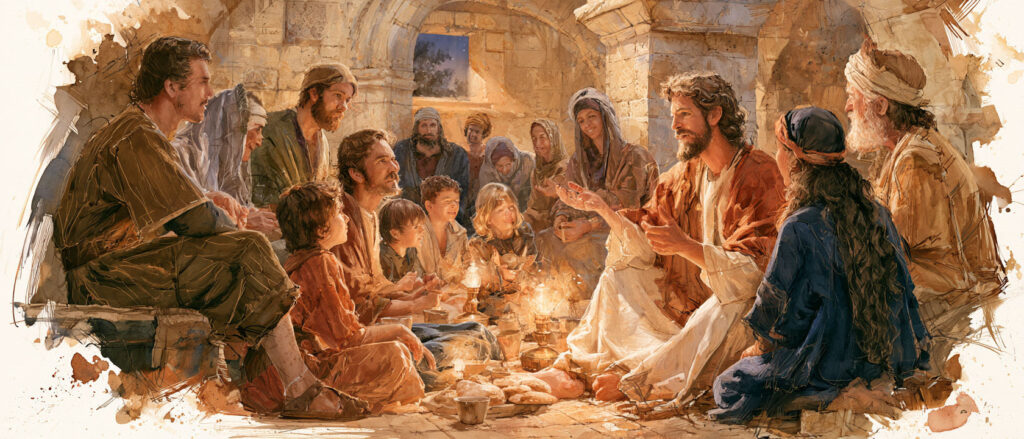
So they met together to pray. They listened to the apostles who had walked with Jesus for three years. I’ve visited ancient houses in Jerusalem, and they look a lot like the two-thousand-year-old houses here in Rome. Imagine sitting in one, listening to Peter, James, and John tell what Jesus did. How many healing stories would it take before you got bored? Would they need a polished performance to hold your attention? Of course not. They were so excited about Jesus and their new life that every story thrilled them.
Then Came the Problems
It didn’t take long, though.
Ananias and Sapphira wanted to impress the church, so they lied (Acts 5). Their motives were rotten, and God acted with startling seriousness: they died. Later, among hundreds or thousands of churches, such drastic measures were rarely seen. But that first church, God’s very special new beginning, had to be kept pure.
Then a complaint arose. Some widows felt they were being overlooked in the daily distribution of food, compared with those of a different language and culture (Acts 6). Most were Jewish, but they belonged to different language groups.
Do any of us speak a language other than English? Come from a culture different from mine? (My wife raises her hand — which is a little scary.) Differences like these don’t have to divide us.
The apostles, in God’s wisdom, had the church choose seven men of good character to handle the matter with love. And it was resolved. After that, we hear little about internal problems in the Jerusalem church.
Sanctification: Letting Go of Junk, Picking Up Gold
As the church spread, people brought into their Christian lives the junk they should have left behind.
Of course, when you accepted Christ, every attitude and value changed instantly, and you’ve thought perfect thoughts ever since. Right?
No. We grow from faith to faith, letting go of junk and picking up gold. There’s a big word for this process — I even had to look it up: sanctification.
Many of the new believers came from pagan backgrounds where worshiping false gods involved practices God’s Word calls evil, and they thought it was right. All of us come from cultures that teach us certain things are right, and God sometimes says, No.
None of us likes being corrected. But God corrects us for our good. We may not keep idols in a back room or carry a little statue in our pocket for luck, as many people did then. But walk around Rome, where so many churches stand on the foundations of ancient pagan temples, and you’ll understand how constant the temptation was. There were temples everywhere, just as there are churches everywhere today.
Some gave in. Paul wrote, “Demas hath forsaken me, having loved this present world” (2 Timothy 4:10). I think Rome was as much a party city then as it is now. You can almost sense the grief in those words. It happens.
Fellowship Is Not Optional
This isn’t my idea. If I say something, it might be worth hearing, or it might not. But when God says something, listen.
And God says we need to be part of a fellowship. It isn’t optional. If you want to get in shape physically, eating well and exercising aren’t optional either.
First, we must maintain our relationship with God: “Seek ye first the kingdom of God” (Matthew 6:33). Seek Him, listen to Him, and remember His Word in everything, so we can grow in everything.
Then look at what the first believers did. They prayed together. They learned God’s Word together, rearranging the values in their minds and gaining the mind of Christ. They enjoyed fellowship, and yes, they ate together. Amen to that!
They cared so much for one another that they cared less about their money and possessions. They “had all things common” (Acts 2:44). Anybody want my jacket? That would be easier to give up than my tennis racket. Can I have your golf clubs? Your favorite dress?
These weren’t disciplines they forced themselves into. They came naturally, because they loved Jesus.
When Someone Offends You
But when people truly get to know and love each other, problems will come. Not might. Will. And Jesus told us how to handle them (Matthew 18:15–17). The disciples didn’t particularly like hearing it, and you may not either.
Suppose someone really wrongs you, not with petty things we should let go, but something serious. Perhaps they’re gambling away their money while their children go hungry, or they’ve said something truly out of line. Do you stand up in public, call them out, and make them pay?
No. You go to them one-on-one. It doesn’t need to become a topic of gossip. You don’t need to tell the world you’ve been offended, or lift your nose when they walk into church so they know it.
Imagine I said something foolish to a church member on my way out today. The right response would be for him to call and say, Let’s have coffee. Dave, I love you, but you need to watch that attitude. That’s how it’s done.
Does God have something He’d like to address in your life? I know He’s working on me, and I’ve missed some chances to let Him. Sometimes He’ll use other people to point things out. If I’m broke because I keep buying lottery tickets, a friend who loves me might sit me down and say, Think about it. Who makes the rules? They make them so they win and you lose.
There’s no best culture in this fellowship, except Christian culture. Every one of us learned things growing up that need to change. Sometimes it’s a small adjustment; sometimes it’s a complete U-turn. In love, we can help one another.
Who Am I to Say?
When I arrived at Oklahoma Baptist University at twenty, I went straight to the tennis courts to feed one of my addictions. An “old man” (probably younger than I am now) came out and started giving me tips. I thought, What does this old guy know? I’m the one with the big serve.
Later I learned he ran a tennis shop out of his home and had once coached a young woman who went on to play professionally. Who was I to say he couldn’t teach me?
God may speak to us through other people. And when we speak into someone else’s life, it takes a whole lot of love. It’s easy to stand on a podium and think how much better the world would be if everyone else would just straighten up. That accomplishes little. But if you love someone, you can help them.
Iron Sharpens Iron
“Iron sharpeneth iron” (Proverbs 27:17). How? Through friction, and sometimes sparks fly. We don’t usually love friction. But we can learn to value others’ perspectives and grow a great deal by listening, even when we disagree. That’s part of being the body.
Change is hard. And the longer we put it off, the harder it seems to get. We dig in our heels like mules refusing to be led. So when we speak to someone, we shouldn’t provoke resistance.
If the two of you can work it out, that’s best; then it never becomes a rumor that spreads and gives God a bad name. Most of us want medical problems treated quickly, and it’s the same here.
If it can’t be resolved privately, Jesus says to bring in others. Authority in the church? Some pastors would say, That’s me. I don’t. Authority is us working together. You bring in trusted people to help everyone understand what happened and what can change, so that a life can be improved in Christ. That’s the goal. And it’s much easier when you like the people involved, and know they like you.
So don’t let petty things get in the way of God’s plan for your life. It’s too big and too important.
An Acquired Taste
C. S. Lewis observed that the joys of heaven are, for most of us, an acquired taste.
Have you come to love a food you once refused? I never ate a single bowl of chili in my mother’s house. Then I married, and partly because I didn’t want to disappoint my wife, I tried hers. Now I love it. When I first saw some Italian dishes, I thought, Why would anyone do that? Now they’re among my favorite foods in the world.
The only way to acquire a taste is to try it. “O taste and see that the LORD is good” (Psalm 34:8). Taste the change He wants to bring into your life, and see that it is good.
Above all, taste the Lord Himself. Christianity comes with many good extras, but most are results of our relationship with Him. We don’t enjoy great fellowship because we’re great people; we’re sinners who need His help. We enjoy great fellowship because we love Jesus, and as we draw closer to Him, we draw closer to one another.
Don’t Settle for Ten Dollars
Years ago, a small church in Bryan, Texas, wanted to help people taste the Lord. They drove a van through their poor neighborhood, picked people up for Sunday service, and paid each one ten dollars to attend, which was real money back then.
How sad if, for some, it was only ever about the ten dollars. Ride the van, sit and listen, go home with ten bucks. If that preacher proclaimed that Jesus Christ, the Son of God, died for their sins, and that they could experience resurrection life with the Holy Spirit living in them, and all they took home was the money, they traded the universe for a tiny dish.
Whether you’re a Christian or not, you can miss the greatest treasures by focusing on lesser things.
Divers once discovered an old shipwreck. They brought up shoes, clothing, odds and ends, and went on their way. Later, another team went down, explored a back room, and found a chest so heavy they had to bring in equipment to lift it. When they opened it on deck, it was full of gold.
Many of us collect the interesting extras of the Christian life and miss the gold. The gold is being changed into Christ’s likeness — developing a taste for Him.
Wound Together
A few weeks ago, I showed the children that a rope is made of many small fibers. Pull them apart and you can snap them easily. Wind them together, and the rope can lift enormous weight.
Think of San Francisco’s Golden Gate Bridge, an engineering wonder of the 1930s that people could hardly believe. It spans a vast gap and carries endless cars and heavy trucks. The great cables holding it up aren’t single cables at all. Each one is made of 27,572 individual wires, and each cable weighs more than the Eiffel Tower. Every wire must be precisely aligned and the same length; if one were shorter, it would take the whole load and snap. They hold because they’re bound together.
Do you think you can stand against Satan on your own? Send for the medics now. You’re going to fall.
First, we need the Holy Spirit. And there will be times when you feel completely alone. But God wants to place in your life, through other people, what you need to stand when temptation comes. He ministers to us one-on-one, through His Word, and through His people.
But then I’d have to depend on others. I’d have to admit I’m not perfect, and some of them aren’t either. Yes. So here’s the real question: Do you want to grow closer to Jesus? If you do, it means working with other people.
Joining in Covenant
At Rome Baptist Church, we work together in covenant. If you’re interested in becoming a member, being baptized, or simply enjoying a great Bible study (and a free lunch, like the first church), join our Discovery Class. Taking it isn’t mandatory, unless God tells you otherwise!
Becoming a member involves:
- Being a Christian.
- Making a public profession of faith.
- Attending the Discovery Class.
- Joining in covenant: first with Jesus, and then with one another.
- Sharing your testimony. For some, that’s the big one: I’m not standing up in front of all those people to talk about my walk with Jesus! I stand up every Sunday, and I’ve only been beaten up twice. It’s safe, and it’s important. Even if it’s not here, learn to share your testimony.
This isn’t a sales pitch, and I would never want to pressure anyone. But God tells us we need to be part of each other. We need to be part of other people’s lives, so we can help them in Christ and they can help us, even through difficult times, always in love.
And if you don’t think you need help, let’s talk.