
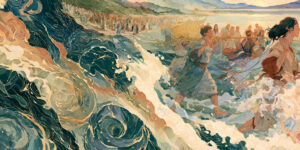
Faith Gets Our Feet Wet
The book of Joshua doesn’t open on a high note. Its first words are essentially: “Moses my servant is dead” (Joshua 1:2). It’s not the start you’d expect from a
Praise be to the God and Father of our Lord Jesus Christ, who has blessed us in the heavenly realms with every spiritual blessing in Christ. For he chose us in him before the creation of the world to be holy and blameless in his sight. In love he predestined us for adoption to sonship through Jesus Christ, in accordance with his pleasure and will— to the praise of his glorious grace, which he has freely given us in the One he loves. In him we have redemption through his blood, the forgiveness of sins, in accordance with the riches of God’s grace that he lavished on us. With all wisdom and understanding, he made known to us the mystery of his will according to his good pleasure, which he purposed in Christ, to be put into effect when the times reach their fulfillment—to bring unity to all things in heaven and on earth under Christ.
In him we were also chosen, having been predestined according to the plan of him who works out everything in conformity with the purpose of his will, in order that we, who were the first to put our hope in Christ, might be for the praise of his glory. And you also were included in Christ when you heard the message of truth, the gospel of your salvation. When you believed, you were marked in him with a seal, the promised Holy Spirit, who is a deposit guaranteeing our inheritance until the redemption of those who are God’s possession—to the praise of his glory.Ephesians 1:3-14
Last week we opened this series with “Blessed by the Father with Every Spiritual Blessing,” focusing on verse 3 and the abundance of spiritual blessings that come from God the Father in the Lord Jesus Christ by virtue of our salvation. This week we turn to the Son. Our theme is redemption and forgiveness — blessings that come to us through blood and according to grace, the two great truths of Ephesians 1:7–10.
“In him we have redemption through his blood, the forgiveness of our trespasses, according to the riches of his grace, which he lavished upon us, in all wisdom and insight, making known to us the mystery of his will, according to his purpose, which he set forth in Christ as a plan for the fullness of time, to unite all things in him, things in heaven and things on earth.” (Ephesians 1:7–10)
In verses 4 through 10, we bless God because He has chosen us to be holy and blameless before Him (v. 4), because He has predestined us for adoption as sons (v. 5), to the praise of His glorious grace in the Beloved — that is, in Christ (v. 6). And He has redeemed and forgiven us in Christ (v. 7).
Redemption and forgiveness are essentially one. There is no redemption without forgiveness, and no forgiveness without redemption. Paul explains them by two realities: blood — the sacrificial death of Christ (v. 7) — and grace, abundant in giving us all wisdom and insight (v. 8), revealing God’s mystery in salvation, His purpose set forth in Christ (v. 9), who was planned for the fullness of time, so that all things in heaven and on earth would unite in Him (v. 10).
There is no desire to be gory here — only to speak the truth in love. Christ’s blood and God’s grace: this is what it took to save you, and me, and the church. This is the content of the gospel. We are blessed because of a substitutionary sacrifice, whereby the righteousness of Christ’s obedience to God’s perfect law — through His sinless life, His death, and His resurrection — was imputed, credited, for free, to all who believe by faith.
Paul summarizes this in Romans 5:18–19: one act of righteousness leads to the justification of all who believe; by one man’s obedience the many are made righteous. Our salvation is in Christ and because of Christ — His perfect obedience and perfect sacrifice. As Philippians 2:8 says, “being found in human form, he humbled himself by becoming obedient to the point of death, even death on a cross.” And God then highly exalted Him to be head over all.
By way of review: the blessings of verse 3 reminded us of the finish, the focus, and the fullness of our salvation. God “has blessed us” — the finish; salvation is completed. “In Christ” — the focus. “With every spiritual blessing in the heavenly places” — the fullness. As the author of Hebrews calls it, this is “such a great salvation” (Hebrews 2:3). Such a great salvation; such a great Savior.
Blessing, we said, is the key word of the passage — perhaps of the entire letter. And here is the point that must not be missed: you cannot walk in a manner worthy of your calling (Ephesians 4:1) if you are not blessed by God and blessing God in return.
Husband, you cannot love your wife as Christ loved the church — sacrificially (Ephesians 5:25–30) — apart from the blessing of our triune God and a Christian life that returns that blessing continually. Wife, you cannot submit to your own husband in the Lord (Ephesians 5:22) without the same source of blessing. Children, you cannot truly obey your parents from the heart without God’s every blessing making your spiritual life vibrant. Without all this, it becomes mere religion — a dead work. It will burden you, and you will not live it with joy.
Blessing God is an essential mark of the church. A church that blesses is a happy church. Enemies offend, assault, persecute — and the Christian blesses. The Christian prays. The Christian loves, because of Christ.
Notice how everything is connected. Blessing God (v. 3) is tied to having redemption in Christ (v. 7). We bless because we have been blessed — and one of these blessings is redemption in the blood of Christ.
This means there is absolute assurance to your salvation. It is secure. Why? Not because I am a good Christian, but because God is a great Savior in Christ. Verse 4 tells us that God chose us — before the foundation of the world. We did not choose Him. Election, God’s choice, grants us assurance, because our salvation belongs to and depends on God alone. No merit, no favor, no contribution of my own.
Listen to Deuteronomy 7:6–8. Moses tells Israel that the Lord chose them not because they were more in number — they were the fewest of all peoples — but “because the Lord loves you and is keeping the oath that he swore to your fathers.” Observe the nature of God’s choosing: it is determined by His love and conditioned by His covenant. It is based on His love, not yours or mine; on His commitment, not ours. And His covenant is eternal — so that when He sets His love on you, it is forever.
This is the same pattern throughout Scripture. Noah found favor in the eyes of the Lord in the midst of the wickedness of men (Genesis 6:8). God called Abraham out of the paganism of his fathers (Genesis 12:1–3). He delivered Moses and all Israel from slavery in Egypt. And here is where you and I come in: He delivered us from captivity to sin and death.
Ephesians 2 puts it starkly: “And you were dead in the trespasses and sins in which you once walked, following the course of this world” (Ephesians 2:1–2). And then comes one of the greatest and shortest sayings in all the Bible: But God. We were on the way to hell — but God. We were trapped in slavery to sin — but God.
God’s choosing leads to holiness: “that we should be holy and blameless before him” (v. 4). The choice brings a declared righteousness in Christ, and then a transformation in sanctification by the power of that same righteousness. A power not my own — an alien righteousness, given by free grace — empowers me to live holy and to want to please the Lord. It is all of God.
The choice before the foundation of the world explains our predestination to adoption as sons (v. 5). All of it belongs to a divine design, a divine purpose — His will. Paul unfolds it in Romans 8:29–30: those whom He foreknew He predestined to be conformed to the image of His Son; those He predestined He called; those He called He justified; those He justified He glorified. A glorious chain of salvation, from beginning to end.
He chose us before time, so that in time and history He would make us sons of God and brothers with Christ. This is why you can say with Paul, by the Spirit of adoption, “Abba! Father!” (Romans 8:15). High and deep theology that comes down to a basic truth even children can respond to: I have a Father. I have gone from a child of wickedness to a son of God, with Christ as my co-heir and brother.
Take a step back and reflect on this plan and purpose of God. Not an ounce — not an iota, not the smallest dot or minute detail of your life in Christ — is out of place, in disorder, or uncertain as to its past, present, and future. You may say, “You don’t know my life.” I don’t need to. The Spirit does. And what the Spirit knows is this: no matter what you are going through, you are safe in the hands of Christ.
Jesus said, “Do not be anxious about your life… Is not life more than food, and the body more than clothing?” (Matthew 6:25). He cares for the birds and the lilies of the field — and you are of more value than they. No single hour of your life in Christ is unaccounted for. There is no hour where God is asleep, no hour where you are abandoned alone in the dark.
This is the very beauty of the Psalms. “O Lord, how many are my foes!… But you, O Lord, are a shield about me, my glory, and the lifter of my head… I lay down and slept; I woke again, for the Lord sustained me” (Psalm 3:1–6). David says, in effect: I have many problems — but I sleep well. I rest, because God is my shield.
Now to verse 7 itself, to understand the cost involved in the blessing of our salvation. Notice the price: God bore a price, which was the blood of His Son. And yet this cost was in conformity to His grace — the riches of it (v. 8).
Notice the language carefully. Paul does not say we have salvation; he says we have redemption — more specific. And he says we have it: it is already in our possession. Done. Completed. Finished.
Redemption is defined by blood — Christ’s blood. Later in the letter Paul will speak of our union with Christ: “he himself is our peace,” who broke down in His flesh the dividing wall of hostility, reconciling us to God in one body through the cross (Ephesians 2:13–16). Redemption is about peace. And peace is needed because of an existing hostility — a hostility that can only be ended through the cross, through the blood of the One on the cross.
What is that hostility? Paul calls it, in Galatians, a curse: the curse upon all who do not abide by everything written in God’s law (Galatians 3:10–12). In plain language: disobedience, sin, and death — which we all suffered under, and under which every unbeliever presently remains.
To understand redemption, we must go back to the Exodus. On the eve of Israel’s deliverance from slavery in Egypt, God told them to take the blood of the lamb and put it on the doorposts and the lintel of their houses (Exodus 12:7). “The blood shall be a sign for you… and when I see the blood, I will pass over you, and no plague will befall you to destroy you, when I strike the land of Egypt” (Exodus 12:13).
The Passover is a portrait of the redemption of God’s people from the curse of sin and death. What did the blood of Christ — His life and death — do? It allowed you to be passed over by God’s judgment. Still to this day. Forever. Redemption means God passed over us, sparing us from His curse. We deserved it; we did not receive it. Instead, we received mercy and abundant grace.
I am a sinner saved by grace. I have been let out of jail. And I live now to proclaim it all, to God’s glory. I live in newness of life because I have been given life. I have been passed over.
But if God passed over me and you, He would be a corrupt judge if He judged no one guilty. Who was not passed over? “Christ redeemed us from the curse of the law by becoming a curse for us — for it is written, ‘Cursed is everyone who is hanged on a tree'” (Galatians 3:13). Who took the curse? Christ. That is why we live in the Son. Abundant grace, through the Son.
You and I were spared — passed over — while He was cursed in our place, so that, as Isaiah says, “he was pierced for our transgressions; he was crushed for our iniquities; upon him was the chastisement that brought us peace, and with his wounds we are healed” (Isaiah 53:5).
Passed over, because He was crushed. We praise the Son.
Next week we continue with the second half of verse 7 and verse 8 — the riches of God’s grace — and the blessings of God’s plan in Christ in verses 9 and 10.
Prayer: Father, we thank You for the abundant grace that gives us life — rejoicing, liberty, spiritual zeal. We live in newness of life, and yet we recognize that there was a cost: Someone was cursed, and that Someone was Your beloved Son, the God-man, our Savior and Lord. We cling to You, we lift You up and bless You in the Son. Help us to live this week, and every week, in light of the Son, as we praise You and worship in Jesus’ name. Amen.
The book of Joshua doesn’t open on a high note. Its first words are essentially: “Moses my servant is dead” (Joshua 1:2). It’s not the start you’d expect from a

If you could share just one verse with someone who doesn’t know the Lord, which would it be? For most of us, the answer comes quickly: John 3:16.
There is something about the name of God. In Scripture, a name is more than what we call someone. To act in His name is to act under His authority,

God gets our attention. He asks us to look honestly at our sin. He covers it. And then — this is the part we often miss — He tells us
God does not bring our sin to light simply to leave us feeling guilty. He wants to free us from what destroys us, restore our relationship with Him, and give

The gospel claims something bold: God offers real peace. Peace with Him, peace inside yourself, and peace with other people. But that peace isn’t automatic…

Advent starts by asking us to slow down and look past the distractions. Every culture wraps Christmas in its own extras—traditions, shopping, decorations, sentimental ideas.