The book of Joshua doesn’t open on a high note. Its first words are essentially: “Moses my servant is dead” (Joshua 1:2). It’s not the start you’d expect from a book about victory, but it sets the stage. The great leader is gone, and Joshua must step into his place.
Then, throughout that first chapter, one phrase is repeated again and again: Be strong and of a good courage. If you were ever a mischievous child, you know that when someone tells you the same thing over and over, it’s because you need to hear it. God kept telling Joshua to be strong and courageous because Joshua needed to hear it.
The Testimony of Rahab
Chapter 2 tells the story of Rahab, and at its heart is a testimony.
Forty years earlier, Israel had stood at the edge of this same land. Twelve spies went in. Two of them, Joshua and Caleb, came back amazed: This place is incredible. The grapes are as big as our heads. We have to go in. The other ten saw only the giants: There’s no chance. We can’t do this. Their fear spread through the people and led to forty years of wandering in the wilderness, until that entire generation, apart from Joshua and Caleb, had died, ending with Moses himself.
Now Joshua sends spies again, and they end up at Rahab’s house. There they hear something remarkable. Rahab tells them that the whole land is melting with fear because of Israel. It’s a striking word, because in Deuteronomy the same image describes the ten fearful spies, whose report made Israel’s heart melt.
But Rahab had heard the story of what God did when He brought His people out of Egypt. She hadn’t seen it — she had only heard it. And it was enough for her to make an astonishing declaration for her time and place: your God is God in heaven above and on earth below (Joshua 2:11).
So the spies return to Joshua with the opposite of the old report: It’s ours. God has already prepared the way. We just have to go in.
A River at Flood
By chapter 3, Israel stands between two things. Behind them is Moses, now buried on Mount Nebo. Before them is a testimony of faith and a land of promise. And between them is a river.
If you’ve visited the Jordan recently, you’ve seen a fairly modest stream. Today it carries only a fraction of the water it once did, because so much is drawn off for drinking and farming. But in ancient times the Jordan flooded every spring. Accounts of its great floods, before the water was diverted, describe it spreading out more than a mile wide, sweeping away houses and even bridges.
Scripture tells us that “Jordan overfloweth all his banks all the time of harvest” (Joshua 3:15). That is exactly when God brought His people to its edge. Of all the times to cross, He brought them at the worst possible moment.
What follows is obviously a miracle. But inside this story are lessons about what God was doing in His people’s hearts, and what He wants to do in ours.
The Crossing
Joshua tells the people to consecrate themselves: not only to pray, but to prepare themselves, setting themselves apart for what God is about to do.
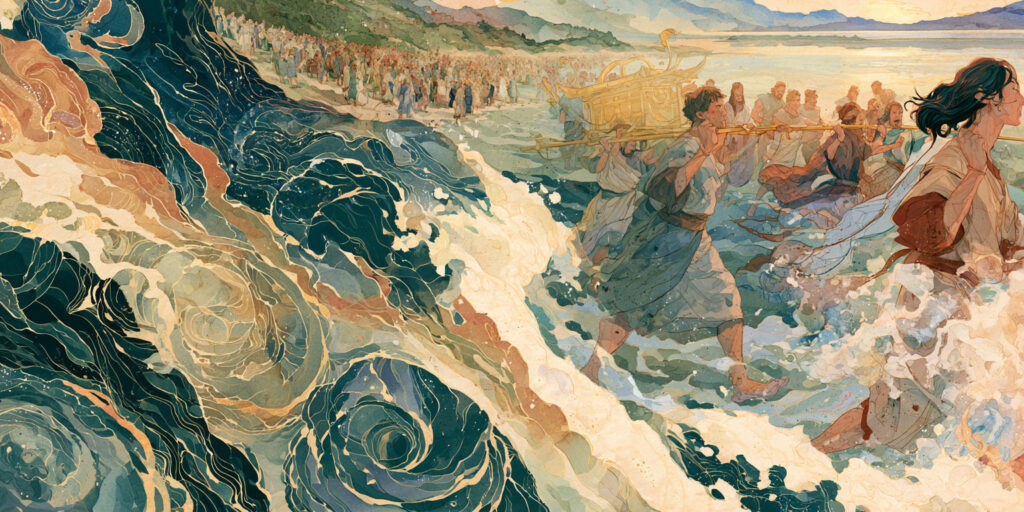
The next morning, the priests lift the ark of the covenant onto their shoulders and walk down to the river. The moment their feet touch the water’s edge, the water upstream stops flowing. Their feet entered the water first, and then God made the way.
The priests walk into the middle of the riverbed and stand there, holding the heavy ark, while the entire nation crosses on dry ground. When everyone has passed, Joshua gives one more instruction: one man from each of the twelve tribes must return to the middle of the river and bring out a stone. With those stones, they will build a memorial so that their children and grandchildren will always know what God did that day, and so that all the nations will know it too.
1. Faith Prepares Us to Follow God into the Unknown
The ark is mentioned again and again in this story, not because it was a precious object, but because it held the word of the Lord: the tablets of the covenant. It represented God’s presence among His people.
Joshua told the people to keep a distance of about two thousand cubits — roughly half a mile — from the ark. Part of that distance expressed reverence for God’s holiness. But it also meant that everyone could clearly see where the ark was going. And then comes my favorite sentence in this chapter:
“…that ye may know the way by which ye must go: for ye have not passed this way heretofore.” (Joshua 3:4)
You have never been this way before.
We all know that feeling. Perhaps it was the day you first arrived in this city, stepped off the plane or the train, and had no idea which way to go. We face it in life, too: a child entering a stage we’ve never navigated, an aging parent, a diagnosis, a loss, a move, a major decision. Not only do we not know what to do, sometimes we struggle even to find faith.
We ask God for a map. Just show me every step. Do I go here? Or here? Instead, God sometimes does something that frustrates us. He says, Walk to the edge of the water. Step in. Then I will act. We know His promise, but we can’t see how we’ll get across. And remember, this wasn’t a puddle on the street. It was a mile of raging water, with thousands upon thousands of people needing to cross.
Yet God doesn’t shame Israel because the way is unfamiliar. He tells them what to do when they don’t know the way: Watch for My presence. Not “research everything, read every book, and maybe write one yourself,” but watch where I am moving, and follow.
He also tells them to consecrate themselves, to prepare their hearts before they arrive at the unknown place.
We often ask God to show us the whole plan, and God answers, Are you watching where I’m leading? Are you doing what I’ve already asked you to do? When we don’t know the way, we keep our eyes on the One who does.
Preparation matters. I grew up playing soccer and loved it, but when I stopped playing in college, I promised myself I might never run again. I didn’t keep that promise. When I was young, I could wake up and run a 5K without any training. These days I’ll play pickleball for two hours without stretching, and I pay for it afterward. We need to prepare before we face what’s coming. We prepare by watching for God’s presence and consecrating ourselves.
So ask yourself: What would it look like to prepare my heart to follow God somewhere I’ve never been, before I get there?
2. Faith Steps Before It Sees
If I had been one of those priests, I’d have had questions. Joshua, have you looked at that river? It’s raging. The houses along the bank have washed away. Are you sure this is what God wants? Could you check one more time? Maybe there’s another path.
We don’t know whether there was any such conversation. What we know is that they faithfully lifted the ark onto their shoulders and walked to the edge of the water.
We want visible proof before we move, but that isn’t always what we receive. I love how the book of Revelation, for all the debate over its beasts and symbols, keeps returning to a simple call: be faithful and endure. It says it again and again — and as we’ve seen, when Scripture repeats something, it’s probably what we need to hear.
The priests were simply being obedient. The command came first, then the step, and then the way opened.
This doesn’t mean faith is taking random risks. The priests weren’t chasing an impulse: Wouldn’t it be exciting to run into the river? God will take care of us! They did precisely what God had laid before them through Joshua. Sometimes faithfulness means dramatic steps; often it means ordinary obedience.
They couldn’t test the water first or dip in a toe. They had to step in. And when they did, God made a way.
The power wasn’t in their feet. It wasn’t even, ultimately, in the ark. The power belonged to God, who had made the promise. Their step didn’t force God’s hand. It was an act of trust in what He had said.
Sometimes God parts the water first and then asks us to walk through. We’ve all had moments when we didn’t know how we’d manage, only to look up and find that everything had already been taken care of. But sometimes He asks us to put our feet in the water first. And often God has already shown us which way to go, and we are the ones refusing to take the step.
3. Faith Stands Firm While Others Cross
We tend to think of faith as moving forward, and sometimes it is. But sometimes faith means standing in one place for a very long time while others cross.
The priests carried the weight of the ark and stood where the water used to flow. Thousands upon thousands passed by. We aren’t told how long it took, but it must have been a long time, and they remained until the entire nation had reached the other side.
Sometimes faith is visible and dramatic. Other times it is a steady presence: you keep praying for someone, keep showing up, keep serving, keep carrying a responsibility, keep holding your ground so that someone else can take their next step toward freedom, healing, maturity, or faith.
Parents do this for their children. Friends do it for one another. Small group leaders do it, and so do the people who serve the church week after week. Often it doesn’t feel spectacular. You’re not out in front; you might be at the very back. But your faithfulness creates space for others to cross on days when they can’t find faith of their own.
I often ask myself: Who stood steady when I didn’t have the faith? Who kept showing up when it was hard for me to stand? Much of my faith was made possible by people whose names the world will never know.
Mature faith doesn’t only ask, How do I get through this? Sometimes it asks, How can I help someone else get through?
4. Faith Remembers What God Has Done
God knows how quickly we forget. (I forget things very quickly — my wife will gladly confirm it.) Israel had just walked across a riverbed on dry ground, and yet they could easily begin to live on the other side as if they had arrived by their own strength. God didn’t want that.
So He told them to build a memory into the landscape. The memorial wasn’t mainly for the men who carried the stones; they had been there and seen the river stop. It was for their children, for generations to come, and for the nations.
That’s exactly what we saw in Rahab’s story. She believed because someone had kept telling the story of the Red Sea for forty years. Now Israel crossed another body of water, and God said: Don’t let this story disappear.
Your act of faith today can become someone else’s testimony tomorrow. Someone may need to hear that you obeyed, stepped into the water, and watched God make a way.
Our stories don’t need polished, perfect endings. We simply tell the truth: We were afraid. God had to tell us again and again to be strong and courageous. We didn’t always know the way, but He led us. We were weak, but He carried us. We didn’t get every outcome we wanted, but God remained faithful and sovereign.
What are the memorial stones in your life? Perhaps they’re literal stones. I have a friend who collects stones from meaningful moments, and one of my daughters collected them for no reason at all. Your memorials might be a journal, a well-worn Bible, a song, a photograph, or a meal you share every year. Or they may simply be the stories you tell about how God showed up when you least expected it.
A Stone of Our Own
Here’s one of mine.
Like many American college students, I was told to go to college and not worry about the loans. Surely I’d land a job that paid a fortune, and paying them back would be easy. Twenty-five or thirty years later, the loans were still there, and I was still waiting for that job.
Then I married Sarah, a woman of unbelievable faith. She would tell me, God is in control of our money. He can take care of this debt if He wants to. And I would answer, I love you — but that’s not how money works. She’d look at me and say, Aren’t you a pastor?
We prayed about it, and she prayed even more. We kept doing everything we were supposed to do: we made every payment and followed every step of the process. Then one evening, as we sat in a movie theater waiting for the film to start, an email arrived on my phone. I opened it and found that my student loans had been wiped clean.
I turned to my wife and said, You’re absolutely ridiculous. How does this even happen?
That story isn’t about a government program. It’s about what God showed us through my wife’s faith. She believed when I didn’t. And so it has become a memorial stone for us. We tell it often, not to boast, but because it reminds us that God is in control of our finances and of our lives.
The God of the Red Sea Is the God of the Jordan
Joshua makes the purpose of the memorial plain:
“That all the people of the earth might know the hand of the LORD, that it is mighty: that ye might fear the LORD your God for ever.” (Joshua 4:24)
Just before that, Joshua deliberately connects this crossing with the Red Sea (Joshua 4:23). At the Red Sea, God brought His people out of slavery. At the Jordan, He brought them into the land of promise. In both places, His people faced water they could not cross, and in both places, God made a dry path through.
Yet this new generation couldn’t live forever on their parents’ memory. They needed their own story of faith. So do we. At some point, each of us must respond to God in our own obedience. We can’t depend on our parents’ faith or on the stories of the past alone.
The setting changes. The generation changes. The obstacles change. But God does not change. The God of the Red Sea is still the God of the Jordan.
What Changed?
Israel began this story on the wrong side of an overflowing river and ended it on dry ground, with twelve stones beside them as evidence of God’s faithfulness.
What changed? Not the river. One of my favorite details is that as soon as the priests stepped out, the water returned to its place, as raging as before.
What changed is that God made a way. And the people responded: they prepared their hearts and followed His presence, the priests stepped into the water before they saw it stop, they stood firm while others crossed, and they built a memorial so the story would never be forgotten.
That is faith in action.
Perhaps you’re standing at the edge of something today. You don’t know how the story will unfold. The water hasn’t moved yet; it may even seem to be rising. The invitation is not to pretend the river is small. It is to remember that God is present, God is faithful, and God can be trusted with your next step.
Four Questions to Take With You
Take a moment to write these down and reflect on them this week:
- Where is God’s presence leading me?
Just as Israel followed the ark, look for where God is moving, and follow. - What step has God already made clear to me?
You may not see the whole path, but what is the next obedient step He has already shown you? - Who needs me to stand firm for them while they cross?
Like the priests in the riverbed, whose journey is your steady faithfulness making possible? - What story of God’s faithfulness do I need to remember, and tell?
What are your memorial stones? Who needs to hear about them?
Step Into the Water
God has been faithful to each of us, though in our struggles we sometimes miss it. Faith isn’t only proven once we reach the other side. It becomes visible when we follow God to the water’s edge, when we put our feet into the water, and when we trust Him to do what only He can do.
God knows who you are. He created each of us on purpose and for a purpose, and He has placed something in you as He calls you forward. The next step may look frightening or uncertain, especially as you enter a new season of life. But you can take it, knowing that God is already there.