If you read through the Bible looking for themes, you’ll soon notice how much of it, in both the Old and New Testaments, is about correction.
That can be discouraging. But think of it this way. When young people join a sports club, they do it because they want to play, and they know a good coach will teach them to play well and enjoy it more. Some of you have found your sport, and you love it because someone invested their life in yours to show you the best way to do it. If you want to learn to sing, it will take a lot of correction, however naturally gifted you are. The same is true of anything we learned in school.
God wants to change our value system into His, so that what breaks His heart breaks ours. That takes both learning and training. Some of us prefer the learning, some the training, but faith demands both.
Still, sometimes we just need something positive. So today, let’s look at one of the most positive pictures in Scripture: the first church.
It’s About the Heart
Ask people to name one episode from David’s life, and most will say Bathsheba. Others remember that near the end of his life he took a census and was punished for it (2 Samuel 24).
We might conclude that counting people is wrong. But God commanded Moses to take a census (Numbers 1). The problem wasn’t the census itself. It was David’s motivation and his disobedience to God. At times, God’s people have been counted, organized, and categorized so that His ministry could be administered well. What matters is whether we’re thinking God’s thoughts and working with Him.
That brings me to a topic with many different opinions attached: church membership.
Open to Everyone, and Something More
For fourteen years we lived in a small town in Colorado. There was another church there — a good church, I think — where membership simply didn’t exist. If they held a business meeting to decide something involving a great deal of money, someone could walk in off the street, sit down, and vote.
We don’t operate that way here.
Let me be clear: everyone is welcome at Rome Baptist Church. Anyone may join our worship services and our teaching. Even if you’ve never set foot in a church before, we want you here, including at our Christmas celebrations.
But there’s also a difference between attending and belonging. Whether it’s a book club, a choir, or a team, belonging brings certain realities with it, including accountability: being held accountable, and helping hold others accountable.
God Works Through a People
In the Old Testament, if you wanted to see what God was doing, you looked mostly at the nation of Israel. There were exceptions, like Melchizedek, and God certainly cared about everyone else. But His plan was to work through His people so that the rest of the world would see His blessings in their lives and want to know Him too.
Was Israel perfect? Sometimes it was the last place you’d want to look to see God at work. Yet that was His plan.
Today we have it so much easier. People can look at the church, see Christians, and say, I want what they have.
That’s exactly what happened to me. At eighteen, I thought I had the world on a string. I knew everything (I’ve forgotten most of it since). But I saw people who had something I wanted, and that’s when I began following Christ.
Not Consumers, but Family
Becoming a Christian begins with forgiveness, the start of a relationship with God that Paul loved to describe as being in Christ, because the Holy Spirit now lives in you. From there, you need to read the Bible to understand who God is, what He wants to give you, and how to receive it.
One of the things He wants to give you is a family.
Sadly, many people approach church as consumers: Where can I get the most while giving the least? That isn’t God’s plan. That may be what first draws us in, but God wants to mature us until His heart becomes our heart and His values become ours. And part of that maturity is recognizing that we need what the body of Christ has to offer.
I could try to argue that I’m too spiritual to need anyone. I’ve been to seminary. I’ve been a pastor for forty years. That would be foolish. Yet I’ve spent more time than you’d believe listening to people explain why they don’t go to church because of everything that’s wrong with church members. I could write a book.
Over the last few years I’ve had to see a doctor a number of times, after decades of avoiding it. Walking through the clinic, I could look into every room and say, Everyone here is sick. Someone has a broken leg. Someone needs surgery. I’m not coming to a place like this! But that’s exactly what a clinic is for. And God has chosen to work with imperfect people, together, in relationship.
Back to the Garden
The Bible begins in a beautiful place. Picture the Garden of Eden: a stunning paradise full of animals you got to name (and, I like to imagine, walk up and pet), food everywhere except from one tree, and a person you deeply loved beside you. They were naked and unashamed (Genesis 2:25), completely transparent with each other and with God, who walked with them and cared for them.
Whether we admit it or not, we all long to go back to the garden. Even the counterculture of the American 1960s sang about it. Much of our complaining about this world comes from expecting it to be Eden. But we left the garden because we didn’t want God in charge.
Israel never quite got back there; there were always problems with the Law and with obedience. But in the church, God finally brings His plan to fulfillment: His Holy Spirit living within us. We are in Christ, and our value system begins to change.
And it’s your value system that determines whether you’re content, not how much you own, where you’ve traveled, or what you’ve eaten. True contentment comes through a relationship with God. And His plan includes working together.
The First Church
“Then they that gladly received his word were baptized: and the same day there were added unto them about three thousand souls. And they continued stedfastly in the apostles’ doctrine and fellowship, and in breaking of bread, and in prayers. And fear came upon every soul.” (Acts 2:41–43)
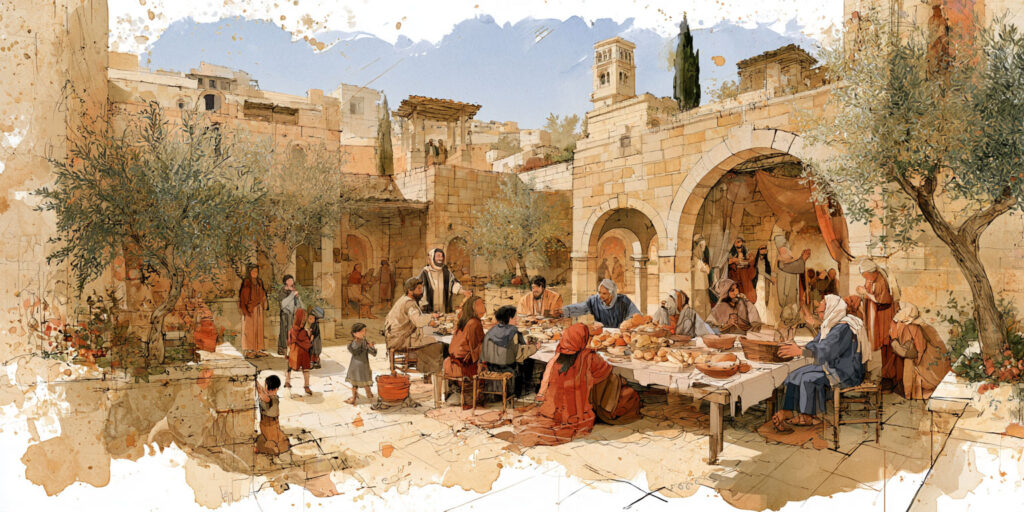
The first church in Jerusalem lived almost as if they were back in the garden. Thousands of people, and everyone getting along!
They gladly received the Word. They were baptized, making a public profession of faith: I belong to Jesus. I have died to myself and risen to a new life in His power. Then they devoted themselves to the apostles’ teaching, to fellowship, to sharing meals together, and to prayer.
And “fear came upon every soul.” I don’t think that means they were afraid to leave home, even though the authorities had played a role in killing Jesus. I believe it means they came to understand who God is. The better we know God, the more we realize the reverence He deserves. No one grows proud as they come to know God; we’re all driven to humility.
They weren’t obeying reluctantly. They loved doing what God wanted, because what He wanted was the best thing for them. That’s how you know things are right: you want to do what God asks.
People saw what God was doing in their lives, and they wanted it too. In a short time, the church grew from three thousand to about five thousand (Acts 4:4). And it happened through people working together.
So let me ask: are you walking in that garden? Are you enjoying the people God has placed in your life? (I’m not suggesting you climb over a fence and pet a tiger.) If we don’t desire God’s will for our lives, and if we aren’t enjoying it, something is wrong.
Becoming a Member of Rome Baptist Church
Different churches approach membership in different ways, and I won’t say everyone else is wrong. Here is how we do it:
- Be a Christian. Membership begins with your own choice to follow Christ and receive His forgiveness.
- Make a public profession of faith through baptism. Jesus made baptism important, so we do too. Going under the water, we proclaim our death to selfishness; rising, we proclaim new life, just as Jesus rose from the dead.
- Want to belong. No one should ever be forced to become a member. It must be your own desire to be part of this fellowship.
- Take the membership Bible study. Some say they endure it; I say we enjoy it. We go through the basics, and you decide whether you agree enough to join. If not, you’re always welcome to keep attending. Membership isn’t required to be part of our services.
- Fill out a short form. We work within Italian legal requirements, and we also want a record of your being part of our church.
- Share your testimony before the congregation.
- Accept the invitation to serve. You’ll be invited, never forced, and you’ll choose how you serve.
Accountability, in Love
Belonging brings accountability. Members have a voice in the life of the church, and the church can lovingly call members to live as God wants. We encourage one another gently, knowing none of us is perfect. If you keep kicking the ball out of bounds, a teammate will remind you: The goal is over there.
Active for the Kingdom
Membership also means being active for the kingdom. There are a hundred ways to serve here. Any honest Christian will admit we could all be more active, just as I could stand to be more active physically. And serving is for our own good.
No Incognito Christians
Jesus said, “Whosoever therefore shall confess me before men, him will I confess also before my Father which is in heaven” (Matthew 10:32).
Imagine if, back in university, I had said to the woman who would become my wife: I really like you. Let’s go grab a hamburger (that was all I could afford). But I don’t want anyone to know. Don’t leave campus with me. Meet me around the corner, behind the bush. Would she have agreed?
Yet many of us treat God that way. We’re incognito Christians. You don’t need to tell everyone on the bus about Jesus, but you should be ready to. If you’re unwilling to let people know you’re a Christian, something is wrong.
Why Would You Miss Out?
If you’re visiting and thinking, I don’t live here, so this doesn’t apply to me, I believe it does apply to you, back home. If we’re in a right relationship with Christ, we’ll naturally be drawn to other Christians and to serving. What matters to Jesus will matter to us. What breaks His heart will break ours.
The birth of the church in Jerusalem was the high point of God’s self-revelation to humanity in centuries. Everything else, David defeating Goliath and Israel taking the Promised Land, comes second to this: God living within us through the Holy Spirit, giving us direct access to come boldly to the throne of grace (Hebrews 4:16).
God is now doing things the way He planned for centuries. And we have the opportunity to be part of it.
Why would you miss out?