Advent starts by asking us to slow down and look past the distractions. Every culture wraps Christmas in its own extras—traditions, shopping, decorations, sentimental ideas. Some of that can be beautiful, but it can also drown out the main point. The heart of this season is shockingly simple and endlessly deep: God came to live with us. The Creator stepped into creation, not as a distant voice, but as a human being born into the world like we all were. He came with a purpose, and nothing in history has altered humanity the way Jesus’ coming did.
Advent is meant to steady your focus. It’s a time to remember not just that God came once as a baby, but that He will come again as King. We tend to prefer the gentle image—Jesus in a manger, easy to hold, non-threatening. But the full story includes a second coming where He returns in authority, bringing justice and reckoning. Advent holds both truths together: the humility of His first arrival and the power of His return.
Hoping, Expecting, Looking For
Luke describes the mood of Israel in a single phrase: “the people were waiting expectantly.” They weren’t just curious. They were hungry for God to act. That expectancy matters because it’s more than a vague hope. In everyday life, we say “I hope so” when we’re unsure—about a game outcome, about a plan working out, about something that might happen but might not. Hope in that sense includes doubt.
But expectation is different. If you truly expect something, you don’t just wish—your posture changes. You look for it. You stay alert. You live as if it is coming.
That tension sits at the center of Advent. God wants His people to move from loose hoping to steady expecting, and from expecting to actively looking.
John the Baptist and the Confusion of Expectation
Into that atmosphere of waiting, John the Baptist appears. He preaches with authority, calls people to repentance, and baptizes them in the Jordan. People trek down dangerous, steep roads just to hear him. His impact is huge—so huge that the crowd begins to wonder if he might be the Messiah.
It’s understandable. The Old Testament had promised that someone in the spirit of Elijah would come before the Messiah. John fits that picture. He is powerful, fearless, and clearly sent by God. If you were there, you might have asked the same question: “Is this the One?”
John’s answer is decisive. He refuses to take the place that belongs to Jesus. He tells them he is only preparing the way. He baptizes with water, but the One coming after him will baptize with the Holy Spirit and fire. John is a signpost, not the destination; a voice pointing forward, not the Savior arriving.
The people’s expectation wasn’t wrong. Their target was.
The Messiah Hidden “Under the Bed”
The sermon used a simple childhood story to make this real. A boy wanted an archery set for Christmas. He went down early that morning, looked under the tree, and didn’t see one. Disappointed, he assumed it wasn’t coming. Then his father told him to get the cat from under the bed. As he reached into the dark space, he knocked something aside—there was the archery set, hidden where he hadn’t thought to look.
That’s what happened with Israel. They were hoping for Messiah. They were expecting Messiah. But they were looking in the wrong place and for the wrong shape of fulfillment.
They expected power in the way nations understand power: a political deliverer, a new king like David, a leader who would crush Rome, restore Israel’s dominance, purify the temple, or even rewrite the world in apocalyptic force. Those expectations weren’t random—they were rooted in Scripture. But they were incomplete.
Messiah came “under the bed,” so to speak: hidden in humility, wrapped in flesh, arriving as a baby. God chose to enter the world in a way that invited trust instead of fear. The first coming was designed to be approachable. The second coming will be different.
God’s Pattern: Promises Delivered Through Special Births
Luke’s story also fits a larger biblical rhythm. God often announces His most important moves through impossible or unexpected births. Isaac came when Abraham and Sarah were far beyond normal childbearing years. Samuel was born after Hannah’s long grief. Samson, Joseph, Jacob and Esau—again and again, God places His promise inside a life that should not have existed by ordinary rules.
John the Baptist’s birth to elderly parents continues that pattern. Jesus’ birth to a virgin fulfills it in the most radical way. Special births are God’s way of saying, “I’m about to change everything.”
So when Jesus steps into the Jordan to be baptized, and the heavens respond—Spirit descending like a dove and the Father’s voice naming Him as the beloved Son—the waiting breaks open. Hope is no longer abstract. Expectation becomes sight. The Messiah is here.
Set Your Sails: What Advent Asks of You
Here’s where the text turns toward your life. Advent is not only about remembering that people once waited for Jesus. It’s about how you wait now—how you hope, what you expect, and whether you are actually looking for God’s work.
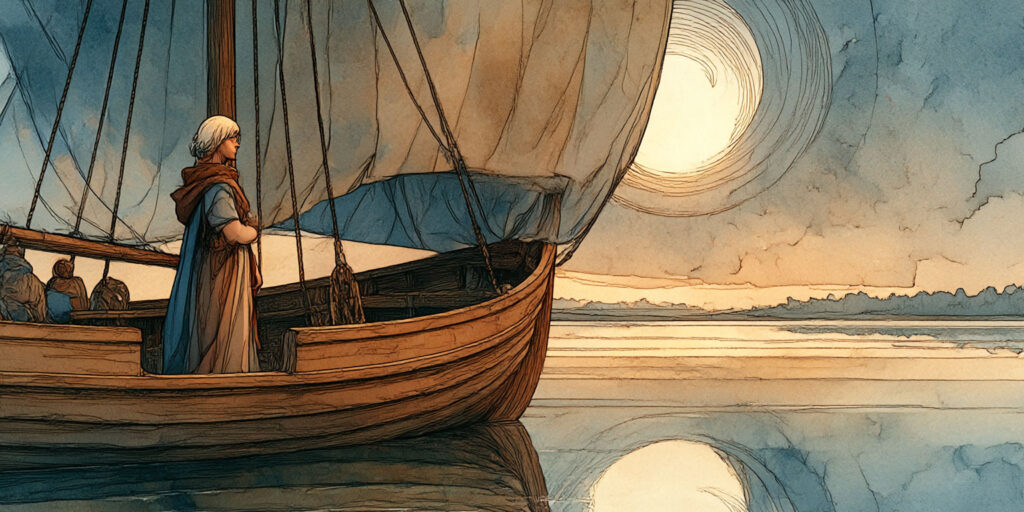
The Hudson Taylor story from the sermon makes the point sharply. On a sailing ship with no wind, the crew is drifting toward an island known for cannibals. The captain begs Taylor to pray. Taylor agrees, but only if the captain first sets the sails. The captain protests—setting sails without wind makes no sense. Taylor insists: “Set the sails, or I won’t pray.” Forty-five minutes later, wind comes so strongly they’re overwhelmed by it.
That’s Advent faith. Not pretending you control God, and not making up promises God never gave. It’s trusting the promises He has given so deeply that you prepare for their fulfillment. You set the sails because you believe your Father keeps His word.
So ask yourself honestly: Are you merely hoping God will be involved in your life?
Are you expecting Him to be involved?
Are you looking for Him—watching for the ways He is moving, and preparing your heart accordingly?
Advent is the season for that shift. From vague hope to real expectancy. From dreamy wishing to active readiness. God came once, exactly as He promised, even if not in the form people imagined. He will come again, exactly as He promised, even if the timing is hidden. And the right response is the same as it was then: keep hope alive, let expectation sharpen it, and live like you’re truly looking for Him.